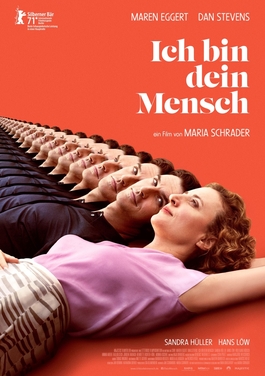
I recently watched I'm Your Man. I like watching foreign language films with the original voices and the subtitles on; I am not fluent enough to understand most movie dialog, but I know enough German to pick out a decent fraction of the words, and I enjoy feeling that current of recognition as the movie plays.
In I'm Your Man, I was struck by the interplay between the meanings of the word "Mensch" and related words, and it revealed a wonderful double meaning in the film's title: in German, "Ich bin dein Mensch" means both "I'm your man" and "I'm your human."
The first English translation for "Mensch" in my Apple dictionary is "man", but a quick search of example sentences at Tatoeba shows how often it means something closer to "person" or "people" or "human." In a film about an android, the title's blur between "man" and "human" felt like a little inside joke that most English-speaking viewers wouldn't get.
And (unsurprisingly) the script is peppered with related words: "Menschenrechte" (human rights), Menschheit (humanity), and the phrase "Das ist menschlich" - "It's human." (Or, "It's only human.")
It was a good movie. I enjoyed seeing Dan Stevens and thought his performance was terrific; I liked the story, I liked Maren Eggert and the fabulous Sandra Hüller, and I enjoyed thinking about the ideas, and about the possibility of love for the main characters.
But my appreciation was just that little bit deeper for the small, very human delight of multiple meanings, and the small surprises to be found in unfamiliar language.