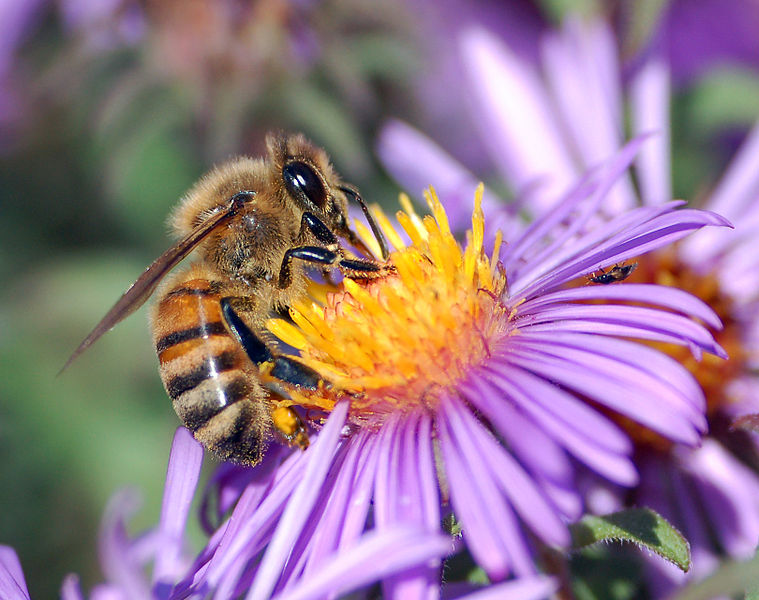
I was so delighted to read about bees, and how they learn from other bees how to open puzzle boxes and pass on waggle dances.
The wonderful article Bees learn to dance and to solve puzzles from their peers, by the wonderful Jennifer Ouellette, highlights two recent studies
(I was also delighted to see that one of the two studies in the article was published in PLoS Biology. I am a huge fan of PLOS, and it still makes me happy to think of them as the Public Library of Science - which I think was their original name.)
(Also, I LOVE bees.)
As so often happens with science articles, I ended up with lots of questions. "A demonstrator bee was trained to perform one of the two solution behaviors and then added to a group of untrained bees." How? How do you train a bee to perform a puzzle-solving behavior?
And in general, I'm just so curious about how scientists come up with their experiments, and then devise ways to carry them out.
Robin Wall Kimmerer's Gathering Moss describes some of her experiments - how she devises ways to isolate and test specific variables. It's so interesting.
It makes me glad and grateful for the ingenuity and tenacity of scientists, for their imagination and their tireless curiosity and their dedication to solving bits of mysteries and then creating new ones.
I'm lucky to live in a world that is so alive with scientists, and so full of information about all their fascinating work.